
Changelog

Follow new updates and improvements to OneRoom Health.

What's New: Doppler & Thermometer Integration

Doppler Ultrasound Support

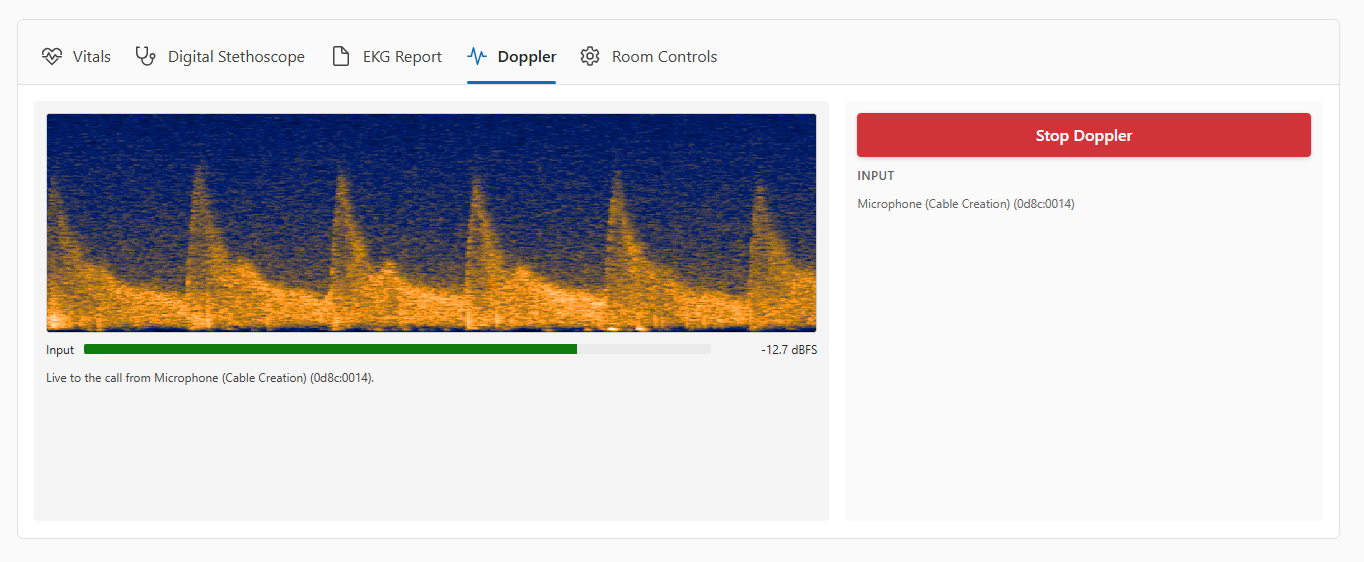
We now support doppler ultrasound for clinical use, letting Medical Assistants stream a handheld probe live into the video call. The Provider hears the ultrasound audio in real time, while the Medical Assistant watches a live waveform on the tablet to help with probe placement.

  • See where to aim — real-time waveform shows arterial flow as repeating pulses and venous flow as steady bands, making it easier to position the probe correctly.

  • Get instant positioning feedback — a live signal-strength meter with color-coded feedback (green, yellow, red) helps you find the strongest signal.

  • Automatic probe detection — the doppler tab only appears when the USB adapter is plugged in; unplugging it automatically stops the stream

  • Audio Output — Doppler audio streams to both the Provider and the CareWall in real time.

Access it from the new Doppler tab whenever a probe is connected.

Thermometer Support

We now support a digital thermometer, so temperature readings can be captured automatically.

  • Automatic temperature readings — plug in the device and scans flow into the vital signs display with no manual entry needed

  • Battery status indicator — a "Battery low" badge appears on the temperature card when the device needs replacements.

  • Live connection status — a green "Thermometer connected" indicator shows when the device is active

  • Manual backup — if you need to enter a temperature manually, you can, the thermometer's next scan will pick back up automatically.

It works right alongside your existing vitals workflow, no new tabs or modes needed.


Catch Up on Recent Updates

Family Participation & Care Team Controls

Whats new

Care Team Moderation

Providers can now manage family participation during calls:

  • Mute/Unmute audio

  • Turn camera on/off

  • Lower raised hands

  • Remove family members from the visit

When muted or camera-locked by staff, family members cannot toggle these controls themselves and see an explanation message.

Hand Raise Feature

Family members can now raise their hand during a visit to signal they need attention. Care providers see a hand icon (✋) on the family member's video tile in real-time.

Live Vitals Display

Providers can share real-time vital signs with family members during appointments. When enabled, family sees an overlay displaying:

  • Blood Pressure

  • Pulse Rate

  • O2 Saturation

  • Temperature

  • Respiratory Rate

  • Height & Weight

Provider Scope Sharing

Providers can optionally share medical examination feeds (e.g., scope/ultrasound) with approved family members during visits.

Visit End Confirmation

Family members receive a branded confirmation screen when a visit ends or if they are removed by the care team, with different messaging for each scenario.

Faster Provider Admissions & Theater Mode

What's New

Faster Visit Starts & Provider Alerts

Providers no longer need to wait for the medical assistant to complete the "Mark Ready for Provider" step. When a provider joins during exam prep, the MA receives an instant audio alert and can admit them directly to the call with a single tap. This reduces wait time and keeps patients moving through their visits faster.

For Medical Assistants: When a provider joins during exam prep, you'll receive an instant audio alert and see a notification. You can tap the "Start Visit" button to connect them directly to the call—no need to mark them ready first. You can also continue with exam prep if you're not ready yet.

For Providers: No more spinning wheels. When you arrive during exam prep, you'll see a message letting you know the MA has been notified and will connect you as soon as exam prep is complete.


Theater Mode: Distraction-Free Exams

Providers can now enter Theater Mode from the Provider Dashboard for a cleaner, full-screen view of the patient during active calls. The patient info card and controls fade away, and call buttons hover-reveal when needed—giving you maximum screen real estate for focused patient examination.

How to use it: During an active visit from the Provider Dashboard, look for the Theater Mode button in your call controls (it looks like an expand icon). Click to enter, click again to exit. Your video feed will scale intelligently to fill your screen while maintaining perfect aspect ratio.


Redesigned Provider Dashboard Call Controls

When calling from the Provider Dashboard, call controls now appear as a compact overlay that intelligently reveals on hover (or stays visible on touch devices). This means less screen clutter while video is streaming, and easier access to mute, camera, screen share, and the new Theater Mode toggle—all from the video itself.

For browser/laptop providers: Controls fade in when you hover over the video or focus any control. Touch or click any control to interact.


Technical Improvements

  • Persistent settings: Care wall and provider hub toggles now survive page refreshes, so your layout preferences stick around even during reconnects.

  • Video quality: Optimized local preview rendering to ensure full resolution is always transmitted to the care wall.

  • Stability: Fixed a rare issue where video tiles could freeze momentarily during layout changes.

Earlier updates